
Voronezh Regional Art Museum. I.N. Kramskoy
Voronezh Regional Art Museum. I.N. Kramskoy

+7 (473) 255-38-67


Архив постов: September 2017
Konchalovsky Petr Petrovich
September 27, 2017
21.02.1876 – 02.02.1956
February 21, 1876 in the city of Slavyansk, Kharkov region, the artist Peter Konchalovsky was born. Education in the art of painting, he began to receive even in the drawing school in Kharkov. Subsequently, Peter attended the evening courses of the SPSU, he studied at the Paris Academy of R. Julian and until 1905 at the St. Petersburg Academy of Arts.
The flowering of Konchalovsky’s art came at the beginning of the twentieth century, when artistic traditions were rapidly changing and revised. Konchalovsky became one of the founders of the society “Jack of Diamonds” and his chairman subsequently. This association aspired to the embodiment of living, natural, tangible forms on canvas. These artists turned to non-professional and folk painting. In his early works Konchalovsky tries to make every thing as strong and dense, while the color is called upon to submit the thing itself, to give it mass and form. Early still lifes are executed in the spirit of Fauvism and Cubism. The same applies to the image of a person. It is shown powerfully and seamlessly – “Potret Matador”, “Family Portrait”, “Portrait of the Artist G. B. Yakulov.”
The world view, and, consequently, the creative manner of the artist was significantly corrected by the revolution. After this event Konchalovsky increasingly writes realistic images. In his painting firmly affirmed the motive of love of life. In his works there is a subtlety of color transitions and contrasts.
A trip to the Caucasus, undertaken by the artist in 1927, inspired him to create several canvases dedicated to the work of Lermontov.
Work on paintings Konchalovsky combined with work in theatrical design and illustrations. He took part in the design of the opera “The merchant Kalashnikov” A. G. Rubinshtein. Also, the artist actively engaged in teaching. Since 1918, he worked in the “Free Art Workshops” in Moscow, and from 1926 he became a teacher in VHUTIN. In 1946, Konchalovsky received the title of People’s Artist of the RSFSR, and a year later became a full member of the Academy of Arts of the USSR.
Petr Konchalovsky died on February 2, 1956 in Moscow.
Renoir Pierre Auguste
September 27, 201725.02.1841 – 03.12.1919
The great French artist, one of the founders of Impressionism Auguste Renoir was born in Limoges, in the family of a poor tailor. In 1844 the family of Renoir moved to Paris. At the age of thirteen, Renoir began his career as a painter at the Sevres Manufactory, but the printed decor was faster and cheaper than manual work, and the young man lost his job. Then he began to paint the fans, then he found a new place with the manufacturer, who was engaged in the manufacture of curtains.
In 1862-1864 Renoir studied in Paris at the School of Fine Arts, where he became friends with Claude Monet and Alfred Sisley. Success came to Impressionists far from immediately, at the scandalous exhibition of young artists in the studio of Nadar in 1874, their work was literally destroyed by the contemptuous and angry responses of critics and spectators, but the painting written two years later, “Moulin de la Galette”, brought Renoir confession. Painting of the artist captivated contemporaries with a joyous and carefree atmosphere. A light color scheme, the use of transparent strokes and pure colors give Renoir’s works a sunny atmosphere.
“Breakfast rowers”, written in 1881, also filled with peace and serene joy, the picture is particularly distinguished charming girl with a dog, the future wife of the artist, Alina Sharig.
In the 80 years, the artist, who had already achieved fame, suddenly feels dissatisfaction with the former impressionistic manner of painting, the search for new creative development brings him back to academic art. This period of Renoir’s creativity is called “Engrod”, the paintings are characterized by cooler and more refined colors, contours are sharply outlined, a strict interpretation of the composition using rhythmic repetitions.
December 3, 1919 Pierre Auguste Renoir died in Cana from pneumonia at the age of 78 years.
Ge Nikolai Nikolaevich
September 27, 2017
27.02.1831 – 13.04.1894
February 28, 1831 in the family of the Voronezh landowner Nikolai Ge was born a son who became a famous Russian painter and draftsman. Nikolai Nikolaevich’s mother died three days after the birth of the child, and the boy was given up for education in the village, but at the age of ten his father takes Nikolai Ge to Kiev, and he goes to the First Kiev Gymnasium.
While living in St. Petersburg and studying at the mathematical faculty of St. Petersburg University, Nikolai Ge persistently copied pictures in the Hermitage and dreams of starting his studies at the Academy of Arts. In 1850 his dream was fulfilled – Nikolay Ge entered the studio of an academician, professor of painting, a famous Petersburg artist Peter Basin.
In 1857, for the work “Saul at the Endor magic”, the artist receives a Grand Gold Medal, which gave him the right to travel to Europe. Nicholas Ge works a lot, preferring historical and mythological subjects.
At the end of 1869 the artist returned to Russia and entered the cultural life of the capital, becoming one of the organizers and leaders of the Association of Mobile Art Exhibitions created in 1870 (TPHV). Ge painting has undergone dramatic changes. He refused not only from the canons of academicism, but also from the desire for historical concreteness, which so impressed his viewers.
In 1875, Ge permanently left Petersburg and moved to Ukraine, where he bought a small farm in the Chernigov province. In his works of the late period, religious themes predominate. However, the artist painted and portraits. Among these works is the painting in the collection of the Voronezh Regional Art Museum named after IN Kramskoy. The portrait of the peasant is distinguished by its simplicity and truthfulness, the artist’s philosophy of life is reflected in his painting – in the strictness of compositional and ascetic color solutions.
Religious painting of Nicholas Ge shocked by its realism contemporaries, many of his later works, such as the “Crucifixion” in 1892 were banned for display.
Gustave Dore
September 25, 2017
6.01.1832 – 23.01.1883
January 6, 1832 was born the most popular illustrator of the XIX century, the highest paid in France, for 40 years of his creative work he created more than 10 thousand engravings, while never getting classical art education, the legendary Gustave Dore.
From his earliest childhood, he was fond of drawing, L. Dyakov in the book about Dora writes that according to the stories of the old nurse of the boy – Franzoise, she had never seen her pupil without a pencil since four years, he even took him to bed with him.
Already at the age of 15, after moving with his mother to Paris, Gustave Dore begins her professional career in the Journal Purrer with a series of drawings about the exploits of Hercules. To this end, the weekly Doré performed about 2,000 satirical cartoons, such as the series “Different publics in Paris” and “The Parisian Menagerie”. But four years later the artist’s collaboration with the magazine ends, Dore is fond of book illustration.
He created engravings for many literary works – these are the poems of Byron, and Gargantua and Pantagruel by François Rabelais, and The Naughty Stories by Honore de Balzac. But special success was brought to him by work on illustrations for Dante’s Divine Comedy. These engravings brought him not only fame, but even greater financial success.
Not only Gustave Dore’s inexhaustible fantasy surprises, but also his amazing performance. In the 1860s he illustrates the “Tales” of Charles Perrault, “Don Quixote” by Cervantes, “The Lost Paradise” by John Milton, “The Trappers of the Sea” by Victor Hugo, “The Fables” by Lafontaine. His illustrations of the Bible are still considered classical and are used in various editions in different languages.
Sargent, John Singer
September 25, 2017
12.01.1856 – 15.04.1925
John Singer Sargent was born into the family of “wandering Americans” – the Sargent family spent the winter months in Italy, and in summer moved to one of the resort cities of France, Switzerland or Germany.
John Sargent dreamed of becoming an artist from childhood, and when he was 18, his parents allowed his son to settle in Paris, where he began to take lessons from Charles Emile Durand, a popular portraitist at that time. It is in this genre that glory awaits John Sargent himself.
Not having finished his studies, Sargent begins to exhibit his works at the Salon, the largest annual exhibition in Paris. Paris in the second half of the XIX century was recognized as the artistic capital of the world, and the success of the painter in the Salon brought worldwide fame, and, of course, many orders. It was such a happy creative destiny that developed in John Sargent. Despite the huge number of exhibitions and orders, the habit of moving from place to place, inherited from parents, did not allow the artist to settle. In 1879, he traveled to Spain and North Africa, and in 1880 visited the Netherlands.
Sargent’s success was unexpectedly overshadowed by the scandal that broke out in 1884. The reason was the painting “Madame X”, exhibited by him in the Salon. This portrait depicts the wife of the influential banker Virginia Gottro. This work can hardly seem indecent to today’s viewer, but at the end of the XIX century, in the era of Puritan morality, both the open outfit of the model and its position seemed extremely challenging to the public. Frustrated with the scandal, Sargent went to London, where he decided to settle permanently.
A great recognition the artist enjoyed in the United States, where he visited in 1887-88. During his visit to Boston, his personal exhibition was a great success. Later Sargent achieved recognition in England – in 1894 he was elected to the Royal Academy of Arts.
In 1890, he accepted an order for the design of the building of the new Public Library in Boston. The walls of the library Sargent decorated with a series of frescoes, written on historical and religious subjects. The frescoes were finished only in 1916 and proved so successful that Sargent immediately received a new order – from 1916 to 1925 he worked on frescos at the Museum of Fine Arts in Boston.
April 15, 1925 Sargent died in a dream of a heart attack in his London home. The artist turned 69 years old. His ashes were buried at Brockwood Cemetery in Woking, Surrey.
Soutine Chaim Solomonovich
September 25, 2017
13.01.1983 – 09.08.1943
Artist of the Paris School, a native of the Russian Empire, was born in Smilovichi, near Minsk, in a poor Jewish family on January 13, 1893. At the age of 14, Khaim entered apprenticeship to the Minsk photographer and retoucher, and in 1910 – left for Vilna, where he studied for three years at the School of Fine Arts. In 1913 Soutine moved to Paris, where he studied for some time at the Academy of Fine Arts. The first years in the capital of France were for Haim Sutin especially difficult, he settled in the famous “Hive” – a haven for beggar artists.
Almost turned out, purple-bloody carcasses – a story that brought Soutine the greatest fame. Aggressive colors, a dramatic contrast of red and dark tones, a broken, distorted perspective – the artist’s works are recognizable at first sight, they fascinate and repel at the same time.
Chaim Soutine liked to paint portraits, but his manner of writing did not imply the possibility of creating a ceremonial portrait, for which the public was ready to spread money, and he himself preferred a different nature: touching, sweet, absurd, beyond the bourgeois norm, children, old women, insane , beggars. In their imperfection, he saw a special tenderness and beauty.
The Jew, writing pictures, far from the academic standard, certainly did not have a chance under the Hitler regime. The Germans, entering in 1940 in Paris, announced a hunt for Chaim Soutine and his paintings, the artist was forced to hide. In March 1941, the artist moved to Champin-sur-Ved, where he will spend the last two years of his life, only occasionally traveling to Paris secretly. On August 9, 1943, Chaim Soutin died in a hospital in Paris, the day after the operation, due to an acute attack of peptic ulcer.
Mane, Eduard
September 25, 2017
23.01.1832 – 30.04.1883
In 1863 the French society was suffocated by indignation – in the Salon was displayed a picture of Edouard Manet “Music in the Tuileries.” She was blown away by criticism. The work was deemed unfinished, but now most art connoisseurs believe that this canvas made a revolution in painting, becoming the first work in the style of impressionism.
The picture “Music in the Tuileries” is full of movement, many heroes do not pose, they are enthusiastically talking, not paying attention to the viewer. And while the work – this is a group portrait, in which Mane portrayed many of his friends and relatives. Here, the artist’s parents, and his younger brother, his beloved Susannah, his friend Charles Baudelaire, critic Zahariya Astru, artist Albert de Balrua and many other representatives of the capital’s beau monde. The master tried to convey an atmosphere of noisy fun, with which a crowd of Parisians are waiting for the start of a weekly concert in the Tuileries garden.
“Music in the Tuileries” is written in quick strokes, the composition is filled with sharp contrasts of light and dark spots, some silhouettes are clearly spelled out, while the rest of the characters in the picture are devoid of light and shadow modeling and seem vague. This idea that the form should not be stable was later taken up by the Impressionists.
The artist, who changed the course of the history of painting, Edouard Manet was born on January 23, 1832 in Paris. His father was the head of the department of the Ministry of Justice, the mother – the daughter of a diplomat. Parents were against the artistic field for their son, and under the pressure of his father he went to the seafaring school in 1847, where, in spite of the failed exams, he was given the opportunity to go on a sailing ship “Le Havre and Guadeloupe”. This journey further convinced Manet of his vocation, and, returning from the voyage, he entered the school of the artist Tom Couture.
After six years of study, Eduard Manet leaves school, tired of the academic framework. Now his training is copying works of old masters from the Louvre collection. The first fame came to the artist in the early 1850s, but the desire to “show life as it is” brought him a scandalous fame. Only in the early 1880’s his view of painting was unconditionally recognized. But by this time Edward Manet was seriously ill. In April 1883 he was amputated to his leg, and eleven days later he died. Edward Manet was buried in the status of one of the greatest and most extraordinary artists of his time.
Montferrin, Auguste
September 25, 2017
23.01.1786 – 10.07.1885
The graphic department of the State Hermitage holds a red and gold embossed folder with drawings, signed: “Various architectural projects presented and dedicated to His Majesty the Emperor of All-Russian Alexander I August Montferrand, a member of the French Academy of Architecture. Paris”. The architect presented his projects to the emperor in 1814, when the Russian troops entered Paris. Already in 1816 Montferrand came to St. Petersburg.
French by birth, Henri Louis Auguste Ricard de Montferrand was born January 23, 1786 in the suburbs of Paris, but his architectural, artistic and construction activities are inextricably linked with Russia.
Having received the post of the senior draftsman of the Committee for Construction and Hydraulic Work, on February 29, 1818, by decree of Emperor Montferrand, the restructuring of St. Isaac’s Cathedral was entrusted. Adhering to the wishes of Alexander I to maximally preserve the existing cathedral, its altar part and the podkupolnye pylons Montferrand leaves unchanged, dismantled the bell tower, altar ledges and the western wall of the cathedral. The building was enlarged in length, and its width remained the same, which made the temple in the plan become rectangular in shape. The height of the vaults did not change either. From the northern and southern sides it was planned to erect colonial porticoes. In 1825, when the construction of the cathedral was already under way, it was decided to modify the building a little. According to the new project of the architect, the cathedral was decorated with four columned porticoes instead of two, the central part was emphasized by a dome square formed by four new supporting pylons, which eliminated the sagging of the dome. At the corners of the main volume were installed four bell towers, as if embedded in walls. Now they were located closer to the central dome than in the previous project. This further strengthened the square construction of the building, and it was in this form that the St. Isaac’s Cathedral survived to this day.
The second main work of Auguste Montferrand is the Alexander Column. This monument, dedicated to the victory of the Russian troops in the Patriotic War of 1812, is harmoniously entered into the established ensemble of the Palace Square. The architect designed a column of granite monolith 26.5 meters high. Standing on a monumental pedestal in the center of the square, a colossal column of dark red Finnish granite is crowned with a Roman-Doric capitol. At the top of the hemisphere is a bronze statue depicting an angel.
Auguste Montferrand died on June 28, 1858. He bequeathed to bury himself in St. Isaac’s Cathedral, but this was not allowed by Emperor Alexander II, since the architect was a Catholic. The coffin with his body was surrounded around St. Isaac’s Cathedral, but the funeral of the architect was held in the church of St. Catherine. The widow of Montferrand took the architect’s body to Paris, where he was buried in the Montmartre cemetery.
Shishkin Ivan Ivanovich
September 25, 2017
25.01.1832 – 01.04.1989
This belief the young artist Ivan Shishkin adhered to all his life. He was a true researcher of nature, radically changing the attitude to the landscape. Shishkin’s paintings are not romantic scenery, but familiar to every Russian forest and open spaces filled with deep lyricism and love for their country.
Ivan Shishkin was born January 25, 1832 in a patriarchal merchant family in the city of Elabuga. With the permission of his father in 1852, Ivan entered the Moscow School of Painting, Sculpture and Architecture, and four years later – to the Academy of Arts in St. Petersburg. In 1860, after receiving a large gold medal, Ivan Shishkin goes abroad – to Munich. He spends more than a year traveling, visiting many cities in Germany, the Czech Republic, Holland, Switzerland.
In 1870, a new association, the Association of Artistic Travel Exhibitions, Ivan Shishkin, also denied the academicism of the old school, joined the ranks of the “Wanderers”. A year later the first exhibition took place, at which the artist presented his work “Evening”. Despite the success of the professional, the artist’s personal life during these years was full of adversity – his father died, then a small son, his wife was ill. In 1874, Yevgenia Alexandrovna, the artist’s wife, died, leaving him with two children – the daughter of Lydia and the one-year-old son Constantine, who soon died too. Shishkin coped with life’s troubles with a head going into work. At the fourth exhibition of the Wanderers, he presents his new paintings – “Spring in the Pine Forest” and “First Snow.”
Ivan Shishkin tirelessly works – teaches, creates several paintings a year, but a series of tragedies in his life is repeated – just after the birth of his daughter, his second wife Olga Lagoda-Shishkina dies. The artist again goes head to head with creativity and creates such masterpieces of Russian landscape painting as “Pines, illuminated by the sun”, “Opuska”, “Fern”.
In 1897, Ivan Shishkin wrote his last picture – “Ship Grove”, the next work he completed was not to be. The artist died with a brush in front of the easel on April 1, 1898.
Pollock Jackson
September 25, 2017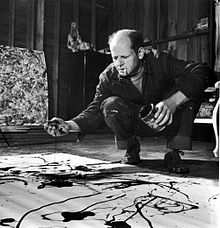
28.01.1912 – 11.08.1956
Paul Jackson Pollock was born January 28, 1912 in Wyoming in a large family – he was the youngest of five sons. The family often moved. The father of the future artist could not find a permanent job – he was a shepherd, a bricklayer, a gardener and so on, until he abandoned his family. Nomadic and almost impoverished childhood left its imprint on the character of Jackson, he grew up a depressed and hot-tempered child.
America in the early 20 th century was far from the leading innovative trends in the visual arts, the center of art life was Paris. However, the situation began to change in the 30s and 40s – fascism, Nazism and World War II forced artists, even well-known masters, to flee to the US. With them came to America major exhibitions of European art, which, along with other Americans, visited and Jackson Pollock. He moved to his brother in New York in 1930 and began to study with the artist Thomas Benton.
In the 1940s, New York became the center of modern artistic life. A huge impression on D. Pollock was produced by Guernica by Pablo Picasso, brought in as a retrospective of Picasso. Fourty years. 1900-1940. ” In the works of D. Polock in the period of 1940-1942, the influence of expressionism is noticeable. However, in 1943 Pollock abandoned figurative and completely immersed in a new trend in painting – abstract expressionism.
Jackson Pollock loved large formats, his works are monumental, and the drawing method is unique. Contemporaries nicknamed him Jack Sprayer, as Pollock abandoned the traditional ways of painting. He took a huge canvas and laid it out on the floor, and then, moving around it, splashed, hurled the paint with brushes and syringes.
The artist’s life ended tragically – he died on August 11, 1956 in a car crash.
- October 2025
- August 2025
- May 2025
- April 2025
- March 2025
- December 2024
- November 2024
- October 2024
- September 2024
- June 2024
- March 2024
- February 2024
- December 2023
- November 2023
- October 2023
- September 2023
- June 2023
- May 2023
- April 2023
- March 2023
- February 2023
- January 2023
- December 2022
- November 2022
- October 2022
- September 2022
- August 2022
- July 2022
- June 2022
- May 2022
- April 2022
- March 2022
- February 2022
- January 2022
- December 2021
- November 2021
- October 2021
- September 2021
- August 2021
- June 2021
- May 2021
- April 2021
- March 2021
- February 2021
- January 2021
- December 2020
- November 2020
- October 2020
- September 2020
- August 2020
- July 2020
- June 2020
- May 2020
- March 2020
- February 2020
- January 2020
- December 2019
- November 2019
- October 2019
- September 2019
- August 2019
- July 2019
- June 2019
- May 2019
- April 2019
- March 2019
- February 2019
- January 2019
- December 2018
- November 2018
- October 2018
- September 2018
- August 2018
- July 2018
- June 2018
- May 2018
- April 2018
- March 2018
- February 2018
- January 2018
- December 2017
- November 2017
- October 2017
- September 2017
- August 2017
- Arts and Crafts
- Badges
- Editions
- Numismatics
- Graphics
- Sculpture
- Porcelain
- Russian painting
- Archeology
- Virtual
- Visitors
- Video
- Available Museum
- Program
- Workshops
- Services
- Services
- Edition
- Publications of the Museum
- Publications staff
- Collections
- Western European painting
- Ancient Egyptian art
- Ancient art
- News
- Events
- archive
- preview
- Birthdays
- calendar
- Exhibition
- Mobile
- archive
- Preview
- Now